
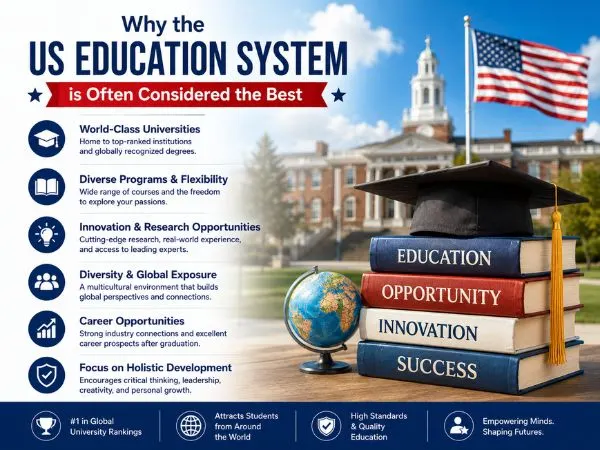
When you look at global K-12 test scores, the United States rarely takes the number one spot—that title usually goes to countries like Singapore or Estonia. However, if you shift the lens to higher education, the conversation completely changes. Year after year, the US remains the undisputed global leader.
From Ivy League prestige to billions of dollars in cutting-edge research funding, there is a reason millions of international students flock to American universities every year.
Here is a breakdown of why the US education system—specifically at the collegiate and university level—is widely considered the best in the world.
1. Unmatched Academic Flexibility
In many countries, you must declare your exact field of study before you even apply to university. If you want to study engineering in the UK or medicine in India, your entire curriculum is heavily locked in from day one.
The US system takes a fundamentally different approach. American universities champion a liberal arts philosophy, which encourages students to explore a wide variety of subjects before committing to a specific career path.
- Undeclared Majors: You can often spend your first two years taking classes in literature, biology, and economics before finally deciding on a major.
- Double Majors and Minors: The system makes it incredibly easy to combine vastly different interests. It is entirely normal to major in Computer Science with a minor in Graphic Design or Philosophy.
This flexibility prevents students from being trapped in a career path they chose at 17 and allows them to adapt to a rapidly changing job market.
2. Dominance in Global Rankings
If you look at the QS World University Rankings or Times Higher Education, American institutions absolutely dominate the top tier.
Also Read : – Best Books to Read for Students: Explore the Best Books in English and Hindi for Students
Universities like MIT, Stanford, Harvard, and Caltech are global household names. However, the true strength of the US system isn’t just the Ivy League; it is the incredibly deep bench of massive, world-class public state universities. Institutions like the University of Michigan, UCLA, and the University of Texas outrank the premier national universities of many entire countries.
Because of this rigorous standard, an American degree carries immense, undeniable weight with multinational employers worldwide.
3. Cutting-Edge Research and Innovation
No country invests in university research quite like the United States. If you are pursuing a STEM (Science, Technology, Engineering, and Mathematics) field, the resources and funding available at American institutions are staggering.
- Corporate Pipelines: Universities often collaborate directly with tech giants in Silicon Valley, massive pharmaceutical companies, and government agencies like NASA or the NIH (National Institutes of Health).
- Undergraduate Access: Unlike many international systems where high-level research is reserved strictly for PhD students, US colleges actively encourage undergraduates to work in high-tech labs, co-author published papers, and secure patents before they even graduate.
4. Holistic Development and Campus Life
The American college experience is a cultural phenomenon. While European or Asian universities often treat higher education strictly as an academic transaction (you commute in, attend lectures, and go home), the US system emphasizes holistic personal development.
American campuses are built to foster community and networking. They offer:
- Extracurricular Hubs: Hundreds of student-run organizations, from competitive debate teams and robotics clubs to student government and Greek life.
- Collegiate Athletics: College sports in the US are heavily funded and globally recognized, teaching teamwork and discipline while providing massive scholarship opportunities for student-athletes.
- Soft Skills: Students are constantly forced to present, debate, and collaborate in group projects, building the communication and leadership skills that modern employers demand.
The Final Verdict
While the American K-12 public school system faces ongoing challenges with standardized testing and equitable funding, its higher education system remains the gold standard. The unique blend of academic freedom, massive research infrastructure, and a fierce focus on holistic student life makes the US the ultimate destination for students seeking innovation and global career opportunities.
Frequently Asked Questions (FAQ)
If the US higher education system is so good, why do US K-12 schools score lower globally?
The US public school system is highly decentralized and primarily funded through local property taxes. This creates massive funding disparities between wealthy and lower-income neighborhoods. While some US public high schools are among the best in the world, the overall national average on global tests like the PISA exam is pulled down by underfunded school districts.
Is the high cost of US higher education really worth it?
While the rising cost of tuition and student loan debt are significant challenges, the return on investment (ROI) from a reputable American university remains incredibly high. The unmatched networking opportunities, access to global tech and finance hubs, and high starting salaries for specialized fields make it a premier choice for career advancement.
How does the “liberal arts” model work for STEM students?
Even if you major in a technical field like Mechanical Engineering, the liberal arts framework requires you to take a few courses in areas like ethics, writing, or history. This approach ensures that scientists and engineers graduate with strong critical thinking, communication, and problem-solving skills, rather than just technical rote knowledge.
Why do international students prefer the US over other destinations?
Beyond the prestige of the degrees, the US offers unique post-graduation work opportunities through programs like OPT (Optional Practical Training), especially for STEM graduates. This allows international students to gain valuable corporate experience at top-tier multinational companies directly after finishing their degrees.
