
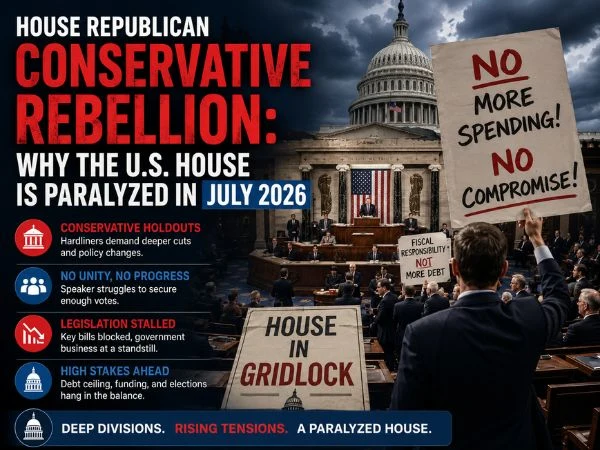
If you have been watching the political news cycle in Google USA recently, you have likely seen searches surging for the “House Republican conservative rebellion.” In late June and into July 2026, the U.S. House of Representatives effectively ground to a halt as a group of GOP hard-liners revolted against their own party leadership.
The standoff has led to cancelled votes, early holiday recesses, and major legislative roadblocks. Here is everything you need to know about the conservative rebellion, why it started, and what it means for the upcoming 2026 elections.
What is the House Republican Conservative Rebellion?
With a historically slim majority in the House, Republican leadership can only afford to lose a handful of votes on any piece of legislation before they are forced to rely on Democrats to pass bills.
A group of over a dozen conservative hard-liners—spearheaded by members like Rep. Anna Paulina Luna and heavily influenced by demands from President Donald Trump—have weaponized this slim margin. By joining Democrats in voting against procedural “rules,” these Republican rebels have successfully tanked their own party’s agenda, freezing the House floor until their specific demands are met.
Also Read : – Lorraine ITV: Presenters, Show Time, Recipes, and Recent Changes
The Root of the Revolt: The SAVE America Act
The primary catalyst for the July 2026 rebellion is a fierce disagreement over election security and border policy.
- The SAVE America Act: The rebel faction is demanding that House Speaker Mike Johnson attach the SAVE America Act—a strict bill requiring proof of citizenship to register to vote in federal elections—to must-pass legislation. President Trump has made this bill his top legislative priority.
- The Strategy: The hard-liners wanted to merge the elections bill with the National Defense Authorization Act (NDAA), the massive annual Pentagon funding bill. They argue that tying the two together is the only way to force the Democrat-controlled Senate to swallow the voting restrictions.
- FISA and Border Security: This isn’t the first blockade of the summer. Earlier in June, a similar rebellion temporarily tanked the reauthorization of FISA Section 702 (a key government surveillance program) over demands for stricter Fourth Amendment protections and codified border security measures.
The Impact: A Frozen House Floor and Cancelled Votes
The immediate result of the conservative revolt was absolute legislative paralysis.
When Speaker Johnson brought up a procedural rule to advance the NDAA and the State Department spending bill, 14 Republicans voted against it. The rule failed 224-198.
Realizing that he could not quickly placate the holdouts and unwilling to risk further embarrassment on the floor, Speaker Johnson abruptly cancelled all remaining votes for the week. He sent lawmakers home for an extended Independence Day recess, leaving major funding bills and critical government reauthorizations in legal limbo.
Key insight: The rebellion highlights a broader shift within the populist wing of the Republican party, which increasingly prioritizes domestic stability, border security, and election integrity over traditional GOP priorities like defense spending and foreign intervention.
What Happens Next?
Lawmakers returned to Washington in mid-July facing a massive backlog. With the August recess rapidly approaching and the 2026 midterm elections looming, Congress has precious few legislative days left to pass funding bills and avoid a government shutdown this fall.
If the conservative blockade holds, leadership may be forced to pass a Continuing Resolution to temporarily freeze federal funding at current levels—a move that typically angers all factions of the party.
Frequently Asked Questions (FAQ)
Why did Republicans vote against their own party’s defense bill?
A group of conservative hard-liners voted against the procedural rule for the National Defense Authorization Act (NDAA) to protest leadership’s failure to attach the SAVE America Act, a strict voter ID and citizenship verification bill, to the must-pass defense legislation.
What is the SAVE America Act?
The SAVE America Act is a legislative package heavily backed by President Donald Trump that would require individuals to provide proof of citizenship to register to vote in federal elections, alongside other strict voter identification requirements.
How does a small group of rebels control the House?
Because the Republican majority in the House is extremely narrow, Speaker Mike Johnson can only afford to lose a few GOP votes. If a small block of Republicans decides to vote with the Democratic minority, they can mathematically block any partisan legislation from moving forward.
