
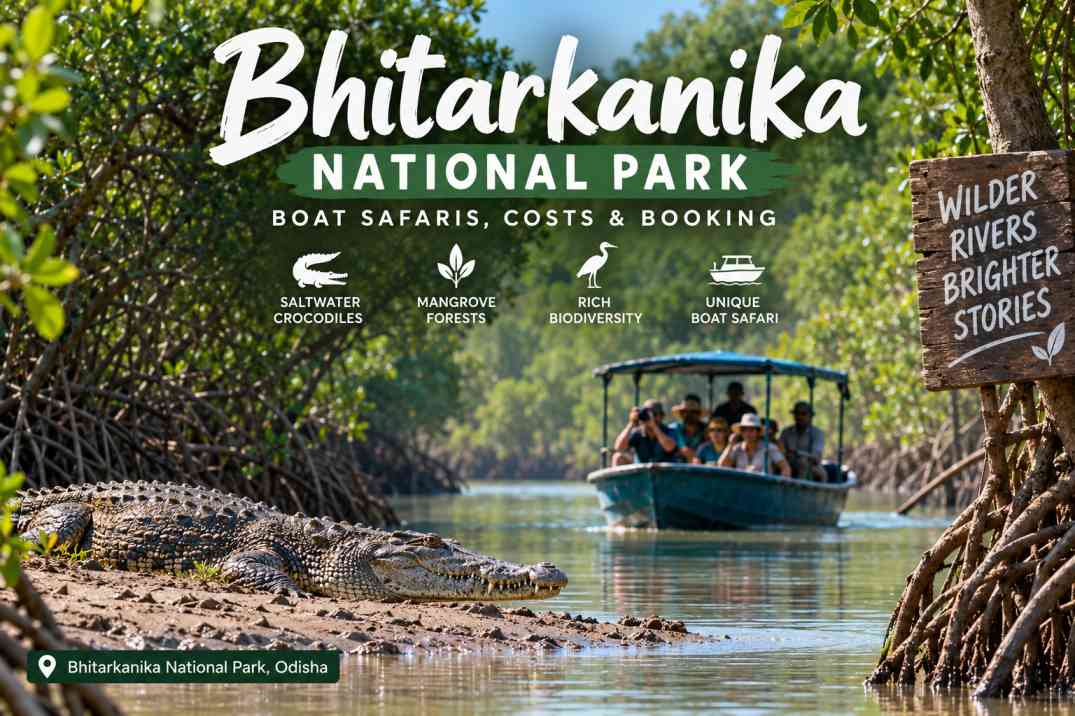
Most wildlife parks in India are explored by Jeep.
Bhitarkanika is different.
There are no safari roads through the main forest area. Instead, you travel by wooden motorboat through narrow mangrove creeks, searching the muddy banks for large saltwater crocodiles.
The park covers about 672 sq km, with a 145 sq km core National Park area where the main boat safari takes place.
The 2026 crocodile census reported 1,858 saltwater crocodiles. The number has drawn debate from wildlife experts. The source says the forest department used a three-day count with drones and AI cameras in January, shorter than the usual ten-day count. Dr. Sudhakar Kar has questioned whether three days were enough for a full count in muddy water conditions.
Your trip needs some planning too.
Tides affect boat movement. Your choice of entry gate changes the route. Cash is useful, phone signals can disappear, and the timing of your safari can affect what wildlife you see.
Here is a practical guide to Bhitarkanika boat safaris, costs, booking, routes, wildlife, stays, safety, and the best time to visit.
What Is Bhitarkanika National Park?
Bhitarkanika is a large mangrove ecosystem in Odisha.
It sits where the Brahmani, Baitarani, and Dhamra rivers meet the sea.
This is not a regular forest road trip. The forest is wet, dense, and full of narrow waterways. Boats take you through these channels in search of crocodiles, birds, deer, monitor lizards, and other animals.
The area was once used as a hunting ground by the King of Kanika.
Today it is protected land and has been listed as a Ramsar Wetland since 2002. The mangroves help protect nearby coastal villages from strong storms and cyclones coming from the Bay of Bengal.
Bhitarkanika at a Glance
| Detail | Information |
|---|---|
| Total sanctuary area | 672 sq km |
| Core National Park | 145 sq km |
| Main attraction | Saltwater crocodiles |
| Main safari | Wooden motorboat |
| Main habitat | Mangrove forest and river channels |
| Main entry gates | Khola and Gupti |
The core park is the main area used for boat safari routes.
Bhitarkanika Entry Fees and Safari Costs in 2026
Arriving without knowing the local system can waste time.
Buy your park entry ticket first. Then arrange your boat and guide.
The source lists the following 2026 entry rates.
Official Park Entry Fees
- Indian visitors: ₹40 per person for small groups
- Group of 10–18 people: ₹25 per person
- Foreign visitors: ₹100 per person
- DSLR camera: ₹50 per day
- Mobile camera: Free
- Professional video camera: ₹5,000 per day
- Drone: Not allowed
Carry cash.
The source says mobile networks become very weak after Rajnagar, with UPI and card machines often failing near the gates. Download offline maps before leaving the main town.
Khola Gate or Gupti Gate?
Choosing the correct gate can shape your entire safari.
Khola Gate
Khola is the main gate for the deeper forest route.
Choose it if your main goal is:
- Saltwater crocodiles
- Dangmal
- Crocodile breeding center
- Inner mangrove channels
The source recommends Khola for visitors focused on the park’s crocodile habitat.
Gupti Gate
Gupti suits travelers who want birds and coastal scenery.
It is linked with routes toward places such as Habalikhati Beach.
Crocodile sightings can be lower here, but the coastal views are a major part of the trip.
Bhitarkanika Boat Safari Prices
You can’t bring your own boat into the safari area.
Approved boats operate from Khola and Gupti, with capacity of up to 18 passengers.
The source lists these 2026 prices:
| Boat Type | Price | Route / Time | Best For |
|---|---|---|---|
| Private Inner Boat | ₹3,000–₹3,500 | Khola to Dangmal, 3–4 hrs | Crocodiles and photography |
| Private Outer Boat | ₹2,000–₹2,500 | Gupti to Habalikhati | Birds and coastal views |
| Shared Government Boat | ₹150–₹400 per seat | Standard route | Budget travelers |
| Night Safari | ₹6,000 + ₹2,000 guide | Special permit | Fishing Cat search |
The source says government boats are usually blue and private boats are often green.
Private boats can be smaller, which lets them move through shallower creeks. Government boats are larger.
Guide Fee and What to Ask
A local forest guide is required for the safari.
The source gives a guide fee of around ₹100–₹200.
Don’t spend the whole trip in silence.
Ask your guide about recent wildlife sightings.
Useful questions from the source include:
- Where were King Cobras seen recently?
- Can the boat use smaller creeks instead of staying on the main channel?
- Can you identify different Kingfisher calls?
Guides often get fresh information from other boat crews and forest staff.
Bhitarkanika Safari Timings
The park is listed as open from 7:00 AM to 5:00 PM.
The source gives two main safari shifts.
Morning Safari
7:30 AM–11:00 AM
This is the main crocodile slot.
Crocodiles often climb onto exposed mud banks to warm themselves in the morning.
Afternoon Safari
1:30 PM–4:30 PM
Bird activity can be better during this period.
Crocodiles may spend more time in deeper water as temperatures rise.
Night Safari
A special night safari may be available through a permit.
The source links this route with the search for the rare Fishing Cat.
The Tide Chart Can Change Your Safari
Simply booking a morning boat isn’t enough.
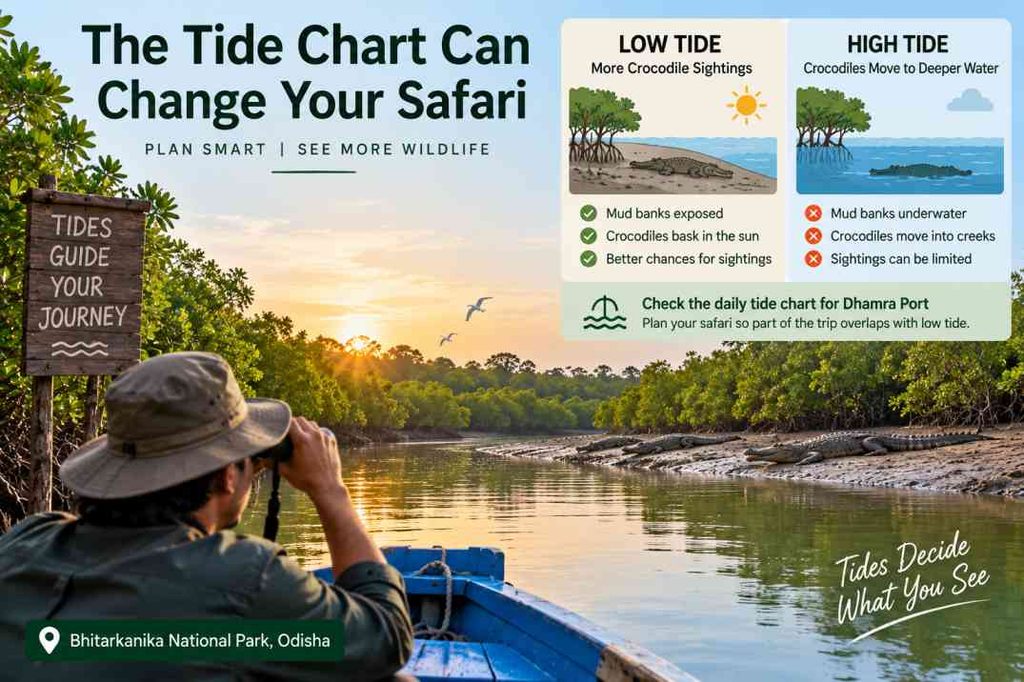
The tide affects what you see.
Saltwater crocodiles often bask on exposed mud banks during low tide. During high tide, those banks can disappear under water, sending crocodiles deeper into the mangroves.
For a better chance of seeing crocodiles, check the daily tide chart before finalizing the safari.
The source suggests checking a local tide service for Dhamra Port and planning the boat ride so part of the trip overlaps with low tide.
This is one of the most useful details to check before your trip.
How to Book a Bhitarkanika Safari
There are several ways to arrange the trip.
1. Book Government Nature Camps
For a stay inside the forest area, such as Dangmal Nature Camp, the source recommends the official ecotourodisha.com website.
Winter dates can fill early, so early booking helps.
The source lists a strict cancellation rule too.
If you arrive around 1.5 hours late for your booked boat slot, the booking can be cancelled without a refund.
2. Book the Boat at Khola
For an offline booking, reach Khola Gate Jetty around 7:00 AM.
At the counter, you can handle:
- Park entry
- Boat booking
- Guide
- Safari departure
Then head to the jetty.
3. Book Through a Private Resort
Many hotels and resorts can arrange the boat for guests.
The resort may add a small service charge, but it can save time at the forest office.
How to Reach Bhitarkanika National Park
The main roads are usable, but the final stretch toward the forest can become rough.
The source says the last 30 km can be bumpy.
By Air
The source lists Bhubaneswar Airport at around 170 km from Bhitarkanika.
A private AC taxi for a round trip is estimated at around ₹6,000–₹7,500.
By Train
The nearest railway station listed is Bhadrak, around 70 km away.
It can be useful for travelers arriving from Kolkata or northern parts of India.
From Bhadrak, continue by taxi or bus toward Chandbali.
By Road
The source gives this Cuttack route:
Cuttack → Salipur → Kendrapara → Rajnagar → Khola Gate
Fill your fuel tank around Kendrapara or Rajnagar.
Fuel stations become harder to find near the forest.
Download offline maps too.
Phone signals can become unreliable near the gates.
Wildlife You Can See in Bhitarkanika
The crocodile is the biggest attraction, but the park has much more.
Saltwater Crocodiles
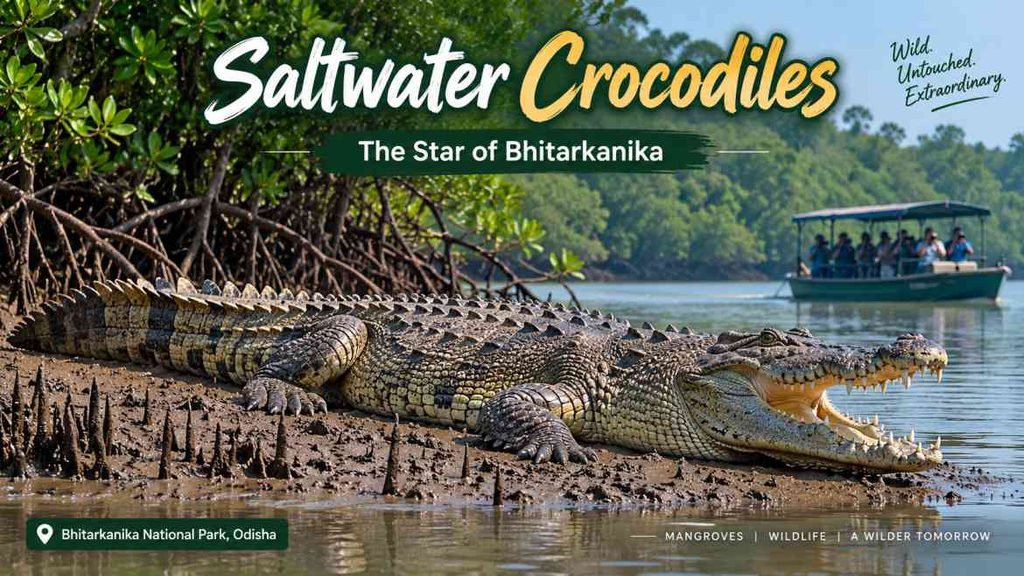
The estuarine crocodile is the star of the safari.
In winter, large crocodiles can be seen resting on exposed muddy banks.
The source describes adults around 10–15 feet long.
Keep your camera ready as you move through the creeks.
A crocodile can stay almost motionless for a long time before sliding into the water.
Eight Types of Kingfishers
Bird lovers have plenty to watch for.
The source lists eight Kingfisher species, including:
- Brown-winged Kingfisher
- Black-capped Kingfisher
- Collared Kingfisher
- Pied Kingfisher
The Pied Kingfisher is easy to spot when it pauses in the air before diving toward the water.
Water Monitor Lizard
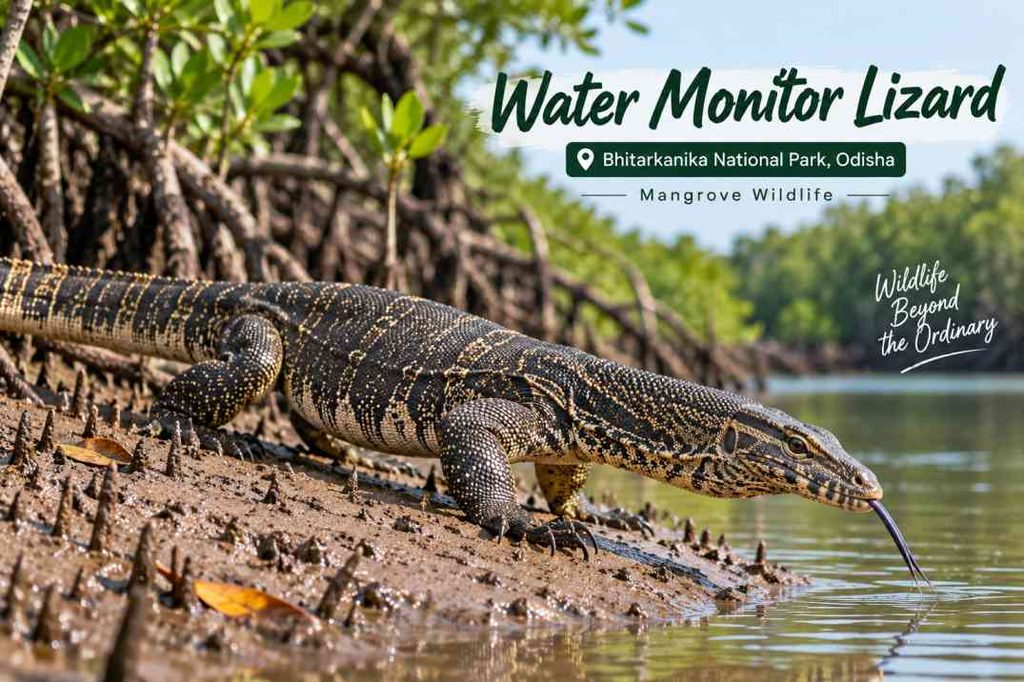
Water monitors can grow very large.
The source gives a possible length of around 8 feet.
You may spot them swimming, climbing roots, or searching for food near bird nests.
Deer and Other Animals
Look toward the banks as the boat moves.
The source mentions:
- Spotted Deer
- Wild Boar
- Monkeys
- Golden Jackals
These animals may appear near the water or muddy shoreline.
Best Time to Visit Bhitarkanika
Weather affects both boat conditions and wildlife sightings.
There is one date rule you should remember.
The source says the park remains closed from May 1 to July 31 each year for the breeding season.
| Season | Months | What to Expect |
|---|---|---|
| Winter | November–February | Excellent weather and strong crocodile sightings |
| Spring | March–April | Hotter, with more crocodiles staying in water |
| Monsoon | May–July | Park closed |
| Post-Monsoon | August–October | Rain, mud, higher water, harder wildlife sightings |
Winter: November to February
This is the source’s best season.
The weather is cooler, and crocodiles often sit on exposed riverbanks for long periods.
March to April
Heat increases.
Crocodiles may spend more time in the water, so sightings can become harder.
August to October
The park reopens on August 1 according to the source.
Rain, muddy roads, and high water can make wildlife spotting harder.
Where to Stay Near Bhitarkanika
There aren’t many large hotels around the park.
Most stays are smaller resorts, homestays, or government nature camps.
Dangmal Nature Camp
This is the main government stay inside the park.
The source describes cottages surrounded by forest and deer.
Book early through ecotourodisha.com, especially for winter dates.
Sand Pebbles Jungle Resort
This property is near Khola Gate.
It offers tent-style rooms, food, and help with boat bookings.
Estuarine Village Resort
This is a more traditional stay with modern bathrooms and local food.
Mangrove Pitta Homestay
A simple budget stay run by a local guide.
The source gives a rate around ₹2,000 per night.
Top Things to Do Inside Bhitarkanika
The boat safari is the main activity, but you can get off at a few safe points.
Dangmal Crocodile Center
See young crocodiles from protected areas and learn about conservation work carried out by the forest department.
Ancient Hunting Tower
A fenced walking trail leads to an old brick structure linked with the former royal hunting area.
The source gives a walking time of around 20 minutes.
Bagagahana Bird Area
During winter, trees here can fill with nesting birds.
Your boat driver may point them out during the safari.
Kalibhanjadiha Island
This quieter route can offer views of wild boars and large monitor lizards.
The source links this route with a remote feel and fewer visitors.
Habalikhati Beach and Gahirmatha
Have an extra day?
You can take a longer boat route toward the coast.
The source connects this area with Gahirmatha Marine Sanctuary, known for Olive Ridley turtle nesting.
From January to March, the arribada can bring large numbers of turtles to the shore.
Bhitarkanika Safari Safety Rules
Saltwater crocodiles are ambush hunters.
Treat the river edge as a wildlife zone at all times.
Keep Your Hands Inside the Boat
Never place your hands or feet outside the boat.
Crocodiles can move very fast over short distances.
Stay Quiet
Avoid loud music and shouting.
Noise can scare animals away before they come into view.
Use Marked Paths
When you leave the boat, stay on the marked concrete paths.
Don’t walk into muddy edges or open riverbank areas.
Is Bhitarkanika Suitable for Seniors?
Yes, with some planning.
The source says the main Khola gate has a solid concrete ramp leading to the boats.
The larger government boats have handrails and sit deep in the water.
At Dangmal, the walking routes are described as flat and paved, with much of the area suitable for wheelchair users.
For older travelers, the main issue is boarding comfort rather than long trekking.
Choose a larger government boat and keep luggage light.
What to Pack for a Bhitarkanika Boat Safari
The river can feel much hotter than expected.
There aren’t shops in the middle of the safari, so carry your own supplies.
Pack:
- Cash
- Water bottle
- Light snacks
- Hat
- Sunglasses
- Sunscreen
- Power bank
- Light cotton clothes
- Comfortable footwear
Muted colors such as green, brown, and grey are suggested by the source for wildlife photography.
Photography Tips for the Moving Boat
Photography here can be tough.
Boats need to stay at least 20 meters from riverbanks, according to the source, so a long lens helps.
The moving boat creates another problem.
You are shooting through dark mangrove shade from a vibrating wooden deck.
The source gives these settings as a starting point:
- Shutter speed: At least 1/1000 sec
- ISO: Often 1600–3200
- Lens: Around 400–600 mm
A tripod isn’t useful on a shaking boat. The source suggests a camera beanbag for support.
The Perfect 2-Day Bhitarkanika Plan
A one-day visit can feel rushed.
A two-day trip gives you time for the main safari without turning the whole trip into a long drive.
Day 1: Arrival
12:00 PM: Reach your hotel and check in.
Have lunch and rest.
3:00 PM: Take an afternoon boat ride from Khola Gate.
Use this trip to enjoy the mangrove scenery and river views.
7:00 PM: Return to the hotel, eat dinner, and sleep early.
Day 2: Main Crocodile Safari
6:30 AM: Wake up and take a packed breakfast.
7:00 AM: Reach Khola Gate and handle the ticket process.
7:30 AM: Start the private boat safari.
Morning light and low-tide conditions can give you better chances of seeing crocodiles on the banks.
10:00 AM: Stop at Dangmal and walk the safe paths.
12:30 PM: Return to Khola Gate, have lunch, and begin the return drive.
How Much Does a Bhitarkanika Trip Cost?
Your final budget depends on transport, hotel type, boat choice, and group size.
The source gives these package estimates for a 3-day trip covering transport from Bhubaneswar, hotel, and boat services:
- Budget: ₹7,000–₹9,000 per person
- Premium: ₹12,000–₹15,000 per person
For smaller groups, a private boat costs more per person.
For bigger groups, the cost can be split across more travelers.
Bhitarkanika vs Sundarbans
The two mangrove regions offer different wildlife experiences.
The source describes the Sundarbans as famous for Bengal tigers, with sightings being rare.
Bhitarkanika is smaller, but saltwater crocodile sightings can be much easier, with birds and other animals appearing along the waterways.
FAQs
How many days are enough for Bhitarkanika?
The source recommends at least two days and one night.
An early morning boat trip is useful for crocodile sightings, so driving in and out on the same day can make the trip tiring.Is Bhitarkanika open in August?
The source says the park reopens on August 1.
Rain can remain heavy in August, and high muddy water can reduce wildlife sightings.
Late October is suggested as a better choice for clearer conditions.How much does a Bhitarkanika package cost?
The source lists roughly ₹7,000–₹9,000 per person for a budget 3-day package and ₹12,000–₹15,000 for a premium package.
Is Bhitarkanika safe for children?
The source says yes, provided children follow the boat rules.
They should remain seated, keep hands inside the boat, and stay on marked paths during island stops.Is Bhitarkanika better than the Sundarbans for crocodiles?
The source presents Bhitarkanika as a place where crocodile sightings can be easier than tiger sightings in the Sundarbans.
The two parks offer different wildlife experiences, so your choice depends on what animals and habitats you want to see.
Final Words
Bhitarkanika is a boat safari rather than a road safari.
The main attraction is the saltwater crocodile, but the mangroves hold far more wildlife. Kingfishers, monitor lizards, deer, wild boars, monkeys, and jackals can all appear during the ride.
Plan around the tide. Pick the right gate. Carry cash. Download offline maps. Keep your hands inside the boat and stay on marked paths.
For the strongest crocodile experience, the source points toward a winter morning safari from Khola Gate, timed around low tide.
That simple planning can turn a basic boat ride into a much better wildlife trip.
